Friday, December 7, 2012

Gripe Session

Shortly after entering Baja California Sur (BCS), I was attacked with an awkward case of upset stomach and dysentery. Definitely not the most pleasant thing in the world, but if I managed to sit still, most of the time it didn’t bother me. So, on the morning we woke at the Rice & Beans Restaurant and Hotel, we decided to move on instead of exploring the mission there. I figured I wouldn’t be able to enjoy it much, so we would catch it on our way back.

As I still wasn’t feeling well by the time we came to Santa Rosalía that day, we bypassed our adventures in that town as well. That is actually a big deal as Santa Rosalía is a French-based town with several items that I wanted to check including a church designed by A.G. Eiffel (yes, designer of the Eiffel Tower in Paris) and a French-style bakery. For me to give up delicious baked goods is a serious thing. We ended up all the way at Bahía Concepción (Conception Bay) that afternoon. Still feeling pained, I didn’t do much anything that day at all. Between treks to the toilet, I did manage to pay the establishment (Buenaventura Resort) for the use of the beach. It was quite the shame to be feeling bad there, as water looked fabulous, and I would have loved to put in the kayak to explore. In the late afternoon, Jonathan offered to drive me to the nearest pharmacy to get whatever we could for me. I would have asked him to do it for me, but as I would have to go to, I didn’t take him up on the offer. The thought of braving the highway at night on top of trying to find a pharmacy in that busy little town (Mulegé) nearby, and the effort of trying to obtain the appropriate medicine (not know what it should be in the first place) in Spanish did not appeal to me. I figured if I wasn’t better by the morning, I would brave it then.

Bahia Concepcion
Our spot along the beach at Bahía Concepción.

Next morning, I was feeling much better, with only a random upper muscle spasm, almost like I had worked out my abs too much the day before. It was pretty windy here, so we decided to move on again. As we drove, we observed that it was bit moister here with more vegetation. Little did I expect that meant more insects. That night we stayed near Puerto Escondido at Playa el Quemado, or Rattlesnake Beach as the English-speakers call it. I had thought about putting out the kayak here as well, but the water wasn’t very conducive, and we didn’t have direct access to the beach, as all the winterers claimed the spots with beach access. To top it off, there were a ton of insects. I even spotted a mosquito in broad daylight when I first got out of the van. Not a good sign. Even bug spray couldn’t keep them at bay. Definitely not a desirable place to stay.

Needless to say, the next morning, we cut out to our next location. We ended up at Campestre La Pila Balneario and Trailer Park. This was (an attempt at) a nice little resort with a pool and cold showers. You could tell that in the busy season, they had bands and bars in service as well. But the pool wasn’t filtered and housed water bugs and toilets were occupied by bugs and mosquitos. At least it was pretty to look at.

Now, it was either at Rattlesnake Beach or at La Pila, but Jonathan and I both seemed to pick up some chigger bites or something. Jonathan’s are concentrated at his feet, but mine cover most of my body. At most of my joints (shoulders, elbows, wrists, knuckle, knee, ankle) and other parts of my body have at least one bite. And, these delinquents sting. I mean, I hate mosquito bites or anything that makes me itch, but I put calamine lotion on them and the itching normally stops and the bump goes away in a day or two. These guys are vicious. Calamine lotion and even my Lanacaine spray with Benzocaine for pain relief doesn’t help relieve the burning and itching feeling. Ironically, I found that my antifungal spray did help relieve the burning sensation a bit. And, since Jonathan is mostly able to not have any issues, of course, it can be deduced that besides my skin being a bit more sensitive and dermographic than his, this insatiable desire to itch and the ensuing pain is all in my head. I did find that if I had something with which to engross my mind, I could bear the pain a bit more, so when we weren’t traveling and listening to our latest audiobook (Shadowmagic 2 by John Lenahan), I was reading a book. However, sometimes forcing myself to read past the pain didn’t work. so Thursday night, Jonathan and I watched The Fellowship of the Ring, more than 2 hours of pain-numbing goodness. Unfortunately none of this helps at night, so my sleep has been haphazard. Friday, these bites are a bit less painful, finally. Hopefully they will continue to heal and disappear. They have long worn out their “welcome.”

DSC01900
Just a sampling of the bites that I obtained. I marked them with an “X” to verify that they weren’t multiplying.

Between my welcome gift of sickness followed by a tango with insects resulting in bites, I am not a fan of the north part of Baja California Sur. Perhaps the southern part will be more enticing, we will see.

Just to get out all my complaints at once, so you don’t have to hear too much about them later, I will go ahead and get out my last gripe. I have been enjoying travelling around Mexico, but I am getting very bored with our meals. Normally, our meals are a selection of rice, pasta, and soups, with an occasional salad or quesadilla, and normally a vegetable thrown in. Since our American-bought stores ran out, it has mostly been rice and pasta. Apparently Mexicans either don’t believe in soup (I think they do, though, since both restaurants we ate at provided it complimentary with the meal) or they believe in making them from scratch. This is really inconvenient as not even Wal-Marts here carry any good soups. They only care cream of corn and tomato soup. How lame is that? Along those lines, they don’t seem to carry any good-looking specimens of one of my favorite vegetables: broccoli (it just goes so well with most of what we eat). Actually, most fruits and vegetables just don’t look very good here unless you are at a port, even then they can be sketch. Obviously, I am getting bored with the lack of variety and vegetables. I guess I have a few options, none of which are very easy:
  • I could start learning how to cook with common Mexican foodstuffs that would do well in the van
    • I am not sure which foods those are
    • I would need to do some internet research
  • I could start eating out more
    • I am slightly hesitant as the last time I did this corresponded with awkward intestinal business
    • Costs more money
    • Not always easy to find something to our liking
  • I could huff it back to the states
    • it is a long distance
    • Not quite ready to leave

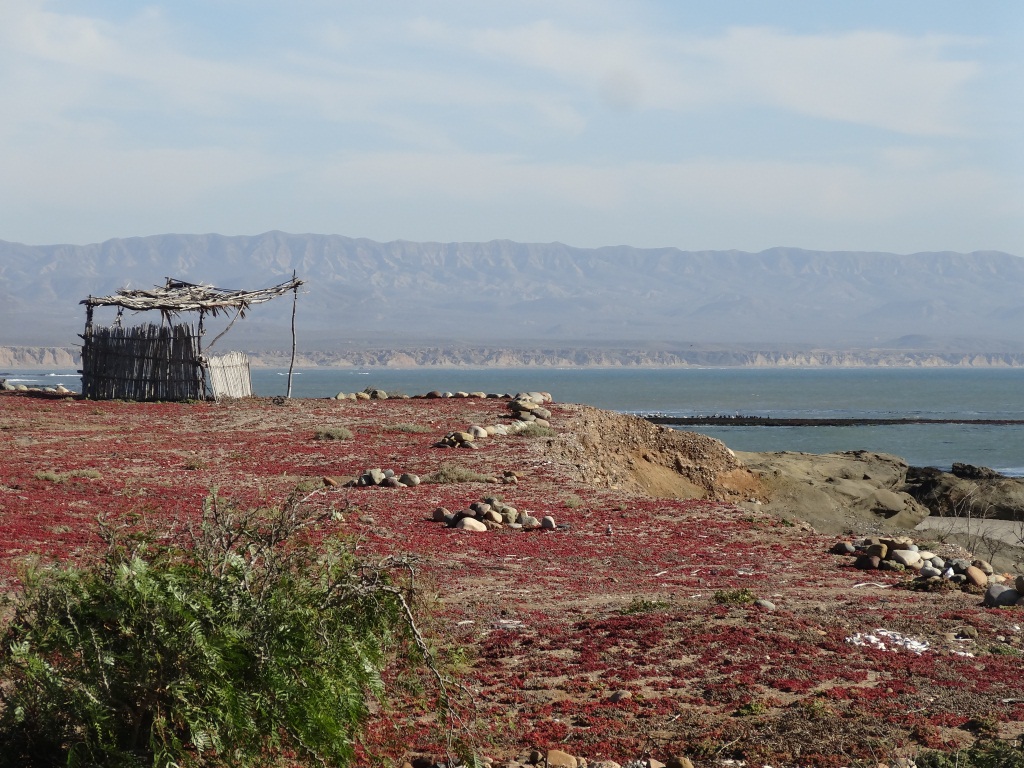
Well, that ends the recount of my grievances for now. I’ll let you know if anymore significant ones come up. ;) Here is a pretty picture as a reward for putting up with my tirade.

DSC01890

Thursday, December 6, 2012

The Art of the Spot

There is a certain art, a learned skill, something not wholly describable by science, behind finding a good camping Spot.  Deciphering the variable plethora of descriptions, the meaning of terms like “good” and “acceptable” or “watch for rabid dogs”…


A good choosing of the Spot, can change a decent night, into an immeasurable hateful one; and a dreadful one into a restful stay.  In a glance we must be able to determine if the quiet circle of RVs is a group of retirees out for a nice getaway, or a crew of exhausted rave goers sleeping off their ecstasy highs. The difference between crazed local lunatic, and the nice elderly proprietor of the local store is surprising low.

If one is willing to do without amenities such as flushing toilets and showers it is entirely possible to find some excellent locations for dirt cheap (under 10$USD).  The Spot below was la Gringa beach in Bahia Los Angeles.  There was no-one else on the beach (over a mile long).  We saw maybe 3 people the two days we were there.

DSC01867

Of course then there is the question of ancillary opportunities.  For example, the Spot below had a large collection of trails circling a meadow and some sweet lake action.  Very nice for toning those calves. 

DSC05043

Of course there is always the desire for solitude, while still being close enough to other travelers to discourage the occasional Smash-N-Grab™®©.  The following Spot was at a desert ranch in the famous Baja Gas-Gap©.  This is a fabled 195 mile run between El Rosario and Villa Jesus Maria in which there is Zero gas stations. You can just barely see the nearest camper in the left background about 300 feet from Chuck.  

DSC01846

The restrooms at this site were, “interesting”.  They probably hadn’t been repaired since they were installed in the 80s (typical of the cheap places we stay) the ladies and mens were painted fluorescent pink and blue respectively (if you squinted enough to see through the cobwebs and dust).  Meh, what can you expect for 60 pesos?

Now we are members of the internet generation, and as you have probably guessed we need internet to post to this glorious blog.  So occasionally we need to find a place to get internet.  In the states and Canada we would just stop at a restaurant or coffee shop with internetage.  The general speed of internet would be fast enough for us to complete our tasks in a few hours.  In Baja is has been a bit different.  Due to the generally slower speeds we have been seeking campgrounds with WIFI so that we can take longer to do our business.  This has been made easier due to the need for fresh water (harder to find public/free water of good quality down here) and our desire not to boondock in awkward locations. Due to these needs we have been staying in RV parks and similar most nights in Baja.  Following are some Spots with WIFI, not as pretty as the more remote, or the boondock spots, but when you need the connectivity…

DSC01773

DSC01705

Now, there remains another important category for the Spot.  This, of course, is the all important BoonDock.  There is an art to boondocking.  This is a difficult art in Baja, as people will live right up next to the water (ocean views I guess?).  Electricity and city water are not needed, just an old trailer and a bucket full of oysters will make a home.  Despite this difficulty the core tenants of boondocking remain the same. The Spot must be sufficiently remote/useless that no-one claims ownership (or cares to put up a sign).  The Spot must have a trail or road in good enough condition to accommodate Chuck (I have driven some astonish crappy roads…).  The spot must have ground where Chuck can be parked and leveled.  The better the view at the Spot, the more crap I will put up with to get/find it.  Following are a few of the better ones.

Stand by for Scenic overload in...

3...


2...


1...


DSC01714 

DSC01715

DSC01736

DSC01499

DSC01494

Lake Mead NRA

Lake Mead NRA

DSC00757

Second favorite place in Alaska in the fall
DSC00673

DSC00672

DSC00528

DSC00527

Sunday, December 2, 2012

First Tastes of Baja California Sur

After leaving Bahía de los Angeles, we ended up crossing the border into Baja California Sur to stay the night in Guerrero Negro. Apparently in Mexico, crossing a state border is almost like crossing national borders. They have a post at the border to protect against spreading of certain agricultural issues. As such, you aren’t supposed to bring any type of fruit across the border, which is on the of the reasons we hesitated crossing on Saturday: we had one lone Granny Smith apple left. Supposedly, they always fumigate your tires as well. When we crossed, it was rather informal. An officer stood in the middle of the road to interrogate both sides of traffic. When he asked about the fruit, he told me I could go ahead, since there was only the one but next time not to have any. And, he didn’t fumigate the tires. Maybe that is during a different season? Regardless, it wasn’t as arduous, as I thought it would be.

Guerrero Negro is one of the newest towns on the Baja. It is a company town that is based on harvesting the salts on the tidal flats nearby. However, it has recently grown acclaim for the whale watching that occurs from late December to April. Since it was not whale-watching time and I would likely completely miss them, I was disillusioned with Guerrero Negro and wasn’t interested in discovering its finer points. We did stay a RV park with a nice restaurant attached. There I enjoyed fish burritos while Jonathan had the white sea bass for dinner. The food was quite delicious; I would recommend it.

The next morning, we were out of breakfast foods again, and in desperate need of clean laundry. So we spent the majority of the morning seeing to those needs. While at the laundromat, I encountered an adorable Siamese kitten, which I played with while we waited on our clothes to dry. She was quite insistent on being petted. I missed my cat.

Laundry done, we went to market to pick up some food. As a note, if you are a fan of parmesan and peanut butter (as we are), before going to another country, you should stock up on these items. They last for a long time and it will save you some serious cash and shortages. Most countries don’t believe in these items, and if they do, they are costly. We had to go to a special, expensive section of the store. These two items together cost us $20. I find that these markets also don’t do dried foods like craisins or mangoes, either, sadly. I have been out of those for a while now. Maybe in Loreto, I will be able to restock my stash.

Leaving Guerrero Negro after our errands were completed, we stopped in San Ignacio. In the middle of the night, I had to make a bathroom run. On my return trip across the lot, another Siamese kitten about the same age as the last one found me. So I got to cuddle her all the way back to the van. When I mentioned the cats to Jonathan, (after warning me that I couldn’t have one) he mentioned that Siamese are bred to be super friendly. I didn’t know that. When I was growing up, we had several generations of Siamese cats. They were all pretty friendly, except for the old matron, Snowball, who wouldn’t put up with nonsense and did her own thing. I had always just thought that I had won over their devotion with my charm, but seeing these kittens and hearing about their breed has made me realize my delusions. They way they warm up to perfect strangers, no wonder they get stolen on a regular basis.

Spanish Words of the Day:
Laundromat: la lavanderia
Market: el mercado
Cat: el gato
kitten: el gatito

Thursday, November 29, 2012

Fantasia

A note from the Webmaster: 

 If you wish to know when new posts are added there is a Follow by Email option directly to the right on this blog.  This is the easiest way to stay up to date, and you can read our posts from your mobile device of choice.  Blogger will not send you spam, and we have no access to the stored email addresses.

Now, back to your regularly scheduled programming...

On the day I crossed the border into Mexico, my sister texted me a few items to check out in our meandering through Baja. In the National Geographic magazine, “50 of the World’s Last Great Places”, which my brother brought, it mentioned Baja California for its aboriginal rock paintings in San Borjitas and the Boojum tree.

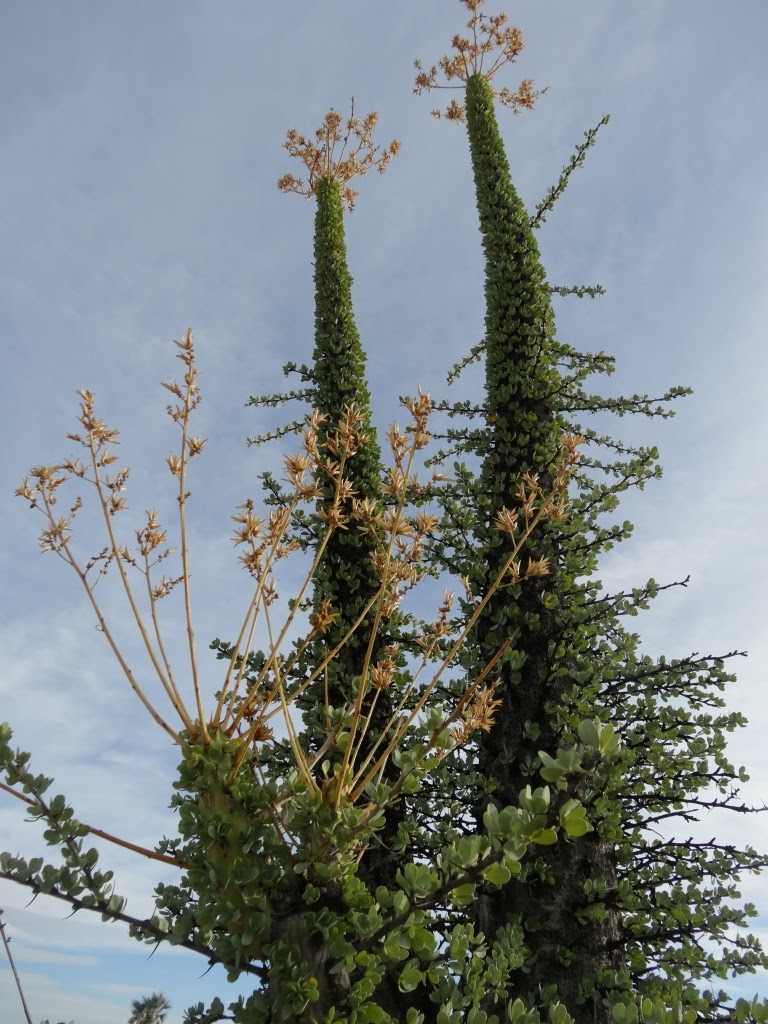
Wednesday, I finally encountered the Boojum tree, aka cirios in Spanish. I hardly knew what to expect, but these beauties were not it. I don’t know if they are more tree or cactus, but at this time of year, they kinda remind me of a Dr. Seuss meets Charlie Brown Christmas tree, with maybe a hit of the Nightmare Before Christmas because of the thorns on the branches.


The Boojum tree is located in this fantastical land called the Valle de los cirios (for you English-speakers, Valley of the Boojums). As you head landward from the coast into the middle of Baja, these trees start to spring up. They are not the only interesting aspect of the valle. There are tall, large cacti that Jonathan thinks might be Saguaros. I have no clue what they might be, but they grow wickedly tall and thick, often with several branches. Aging and growing, the lower parts turn into wood or bark almost.


Then as you get closer to the middle of Baja, there are mounds of “photogenic” rocks. Between the otherworldly Boojums, the outrageous cacti, and the intriguing landscape, the Valle de los cirios is an alluring and beautiful place.


The land didn’t seem to lure Jonathan as much, but I spent an hour traipsing about in the Valle, and could have spent several days there. But, alas we moved on after a day. I do believe Valle de los cirios is a Mexican national park. Apparently, there are a lot of dramatic things to find throughout the park, including a natural pool, surrounded by palms, and the ruins of a mission. Perhaps I will get to see them next time.

Our camp in the Vallewas Rancho Santa Inez. When I went running, I discovered an airstrip that was on the location. Jonathan’s grandparents, Fred and Martha, visited Baja back in the day. Fred piloted a plane, and they had to stop at several spots along the way down to Los Cabos. I have no idea where they stopped, but it reminded me of their journey.

From the Cataviña region, we drove to Bahía de Los Angeles (Angels’ Bay). I guess leaving the Boojums behind was acceptable as we got to the beach again. This bay is a beautiful, rather peaceful inlet of the Gulf of California. It makes me happy and gives me peace just looking at it.

Click on picture for full size.


We made our way to Playa La Gringa, which is aptly named as a white man seems to keep the grounds there. After lunch, I convinced Jonathan to go kayaking along the shore. He acquiesced and we spent a couple hours on the kayak. Halfway through our paddling, we stopped on the shore and explored the shore and point of our protected area. There were all sorts of interesting sea memorabilia washed up along the shorelines.


Spanish Words of the Day:
Tree: árbol
Valley: valle
Pilot: piloto
Air strip: pista de aterrizaje

Tuesday, November 27, 2012

No name :(


From Eréndira, we ventured south to San Quintín and El Rosario. In San Quintín, we stayed at an olive plantation/resort. It was an interesting place that strove to take full advantage of its space. While it was still under some construction to improve the place, it was pretty clean and has great potential.


I wanted to see the bay and beach, which are protected by volcanoes. We did make it to the Old Mill at the San Quintín Bay. The mill is leftover from some agricultural experiment back in the day. From there, the volcanoes looked pretty dormant and unimpressive.


We made a couple of efforts to actually get to a beach and maybe explore the volcanoes more, but all our attempts failed. We don’t have very good maps and many of the roads we tried were ridiculously bumpy.

Arriving in El Rosario on Tuesday, we took a back-road trip to Punta Baja that juts out into the Pacific. After lunching on the cliffs there, we found a beach to go explore.


Apparently there are a few people who live there on the deserted beach trying to make a living clamming and crabbing or such.


We found all sorts of interesting sea creatures in the tidal pools, including snails, hermit crabs, and anemones(?).


Now, El Rosario is known for its restaurant Mama Espinoza’s, most famously for her crab and lobster burritos. Not wanting to cook for dinner, we decided we would try it out. It was an interesting little place. Cactus and whale skeletons decorated the outside, and inside was a shrine to the Baja off-road races.


Since I don’t like shellfish, I asked the server what she recommended otherwise. We ended up with chicken enchiladas. They weren't bad, but they weren't impressive either. I know Mexicans don’t really do cheese that much—it is an expensive commodity, but the enchiladas were topped with an interesting crumbly cheese, I wondered if it was goat’s cheese. I guess you really need to like shellfish for the place to really be great. I did really like the soup that came with it, though. It was simple, brothy, and had an intriguing flavor.

Spanish Words of the Day:
Beach: playa
Shellfish: mariscos
Cheese: queso
Market: mercado

Monday, November 26, 2012

Endearing Eréndira


We spent Saturday and Sunday nights on the banks of the Pacific Ocean north of the small town of Eréndira. This was a delightful area. The perch were we stayed the first night was a popular fishing and clamming area. When we pulled up, there was someone just finishing packing up his fishing gear. At that location were some rocks that jutted out into the ocean. At first, I thought only multitudes of birds (pelicans and seagulls) occupied these rocks, but as I walked out onto the beach, I heard the barking call of a sea lion. Sure enough, on the rocks farther out there was a colony of sea lions sunning themselves.


It was a fun location.  However, the smell of bird poo was a bit overwhelming at times. Saturday right before sundown, Jonathan and I went for a jog along the coastal road. I tell you, there is nothing quite like running along a beach at sunset. As we ran, we scoped out another area that we could pull off and park that would not be so putrid with the avian feces and relocated there when we got back. Before I called it a night, I also did an ab workout. It was definitely a refreshing sensation to do it at dusk with a nearly full moon above.


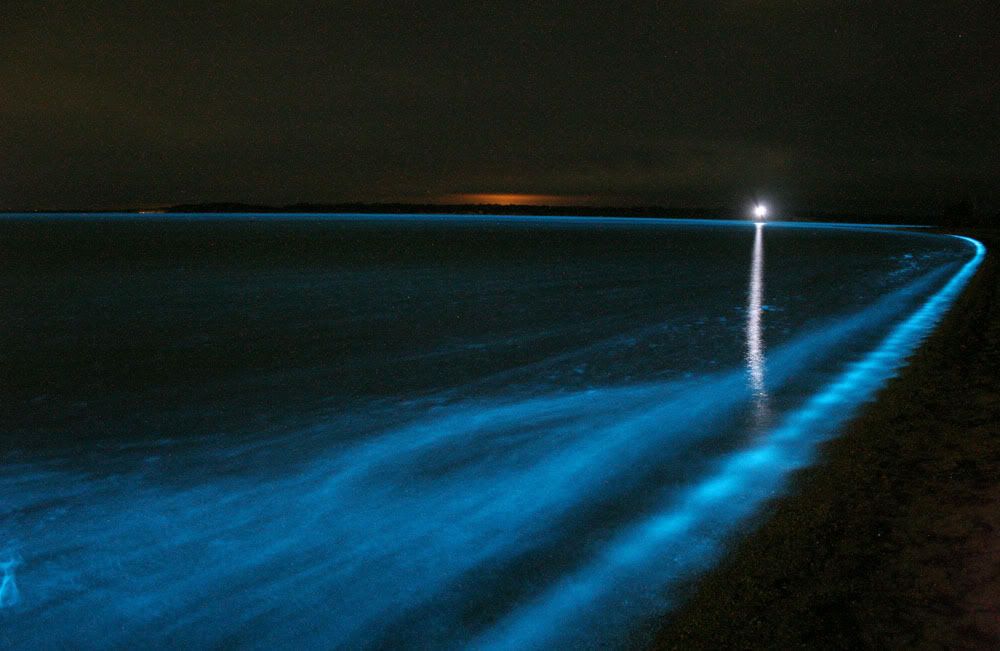
The nights held another surprise. When the sun was gone, you could see the luminescence of the plankton in the crashing breakers. It was a first for me to experience glowing waves. It was especially exciting to learn that it was natural and not the result of some toxic pollution. When the moon went down, the waves were especially bright green-blue.
Stock photo, as our photos gave the camera a conniption. 

Then, to top it off, Monday morning before we left, Jonathan spotted a group of dolphins swimming where the waves broke. At first, we thought they might be shark, but then one poked its head out of the water, and we confirmed they were dolphins. It was pretty exciting.


Spanish words of the day:
Ocean: océano
Sunset: puesta del sol
To swim: nadar

Saturday, November 24, 2012

Chuck; The Van, The Myth, The Legend


And so we have come to the point where we must discuss in depth, our third traveling companion Charles Theodore Finley.  Who is Chuck?  Well, sit back and let me tell you a story as old as Volkswagens and cable TV in 2006.

The Van

Chuck first and foremost, is a Van; or as the EPA prefers it, a “multi-passenger, multi-purpose vehicle”.  A 1982 Volkswagen Vanagon Camper.  But beneath his cool white (paint code LD90) exterior, lays a deep dark secret.  Chuck is a Shagin-Wagen, a super-funk generating machine descended from the lord of all hippy busses, the ‘62 Spilt-Window Westfalia camper.

Chuck's Grandfather

Or at least that’s what this ancient hippy told me in Vegas…
Anyways, He has a few interesting tricks up his sleeves.  First he has 2 fold out twin-ish sized beds.


From what I understand these beds can sleep a total of 3 women and 1 man.  Again, the Vegas Hippy assured me that the 2-2 and 1-3 combinations were impossible due to van physics, who am I to argue with the master?

Additionally Chuck can pop his top to provide an 8ft ceiling and prodigious ventilation when necessary.


Now, don’t get your mind blown by all this Epicness.  There is much more to follow.  Chuck has a stove, a fridge, and a sink.  That’s right, a whole freaking mini-kitchen.


The stove and fridge are powered by a 3 gallon propane tank mounted under the driver’s side.  The sink gets its water from a 12 gallon tank inside the interior cabinetry. 


Now, this is all standard equipment for Westfalia camper vans.  In addition to all this (admitted already awesomeness) we have outfitted Chuck with a variety of upgrades, and improvements. 
Curtains: The previous owner (PO) did some atrocious things to Chuck’s interior.  We remedied that with new upholstery (done by Jen) and new thermal curtains (Jen again).


These curtains contain advanced magnetic wizardry that allows them to stick to metal.  Black magic you say!?  Tis the power of SCIENCE! (you may be a child of the ‘90s, like me, if you just had a flashback to Bill Nye the science guy)

Seats:  Chuck’s front seats were adequate, but not really enough for the amount of driving we do.  We pulled the stock seats and replaced them with early Eurovan seats.  I modified the tracks to fit Chucks frame, Jen re-upholstered them in matching colors and added lumber supports.  I also removed the driver’s side swivel as it is totally useless.  The passenger swivel works very well for us. 


We also added a low-power folding fan.  It gimbals in almost every direction, very nice when the weather gets warm, due to Chuck’s lack of AC.


Lighting: Chuck came from the factory (Westfalia Werke) with the cutting edge in lighting (in 1982…) incandescent lights that use tons of electricity.  This is not a big deal for a home or office where power is mostly unlimited (not free though); but in the van all our electrical gear is powered by a battery bank (separate from the starter battery, cause a dead starter is bad mojo in the boondocks).  This means we are limited on total energy capacity.  The AUX battery bank is only changing when we drive, so extended stops can be an issue.  Thus we tossed the old incandescent lights for the lighting of the future, LEDs.


We decided to use 12v LED strips, which I cut to length and installed in and under chuck.  These lights make 3x the light at half the power usage of the previous ones.  Not only are these strips self-adhesive, they are silicone coated for waterproofing as well.

Shower:  We needed some way to wash the road grime off without freezing or paying for a shower.  Through this need, the power of Google and Amazon, and a 4-year engineering degree; I developed a shower system.

(I'm to lazy to go get a photo of our shower in action, will have to be another day.)

This system uses water from Chuck’s free water tank and pumps it through a heat exchanger that uses hot engine coolant to heat the water.  Then after passing through a thermostatic mixing valve (the thing in your shower that keeps a nearby toilet flushing from scalding you) the water exits through a small spray nozzle.  This system allows us to take warm showers anytime we have water and a warm engine (usually takes about 3-5 minutes of idling to get the water warm enough).  We have a tent-like thingy to cover the rear hatch so we can shower in privacy. 

Stock photo of the Bus Depot Add-A-Room.


Power:  Chuck did not originally come with an AUX battery.  Although almost all later model campers did.  We could have put an AUX battery in the stock location under the driver’s seat, but the small space severely limits the size and thus the capacity of the battery.  Instead of struggling to get a battery under the seat, we opted to install a larger battery bank under the rear bench. 


This battery bank consists of 2 GC-2 type golf cart batteries in series.  They provide around 200 Amp-hours of reliable capacity.  They handle vibration and deep discharges well. The only required maintenance is checking the water.  The AUX bank is connected to Chuck’s charging system with a Blue-Seas battery isolator.  This nifty little device prevents Chuck’s starting battery from being discharged by only connecting the AUX battery to the charging system when the engine is running.


Exterior: Chuck has had a substantial number of exterior modifications in the name of improved driver happiness. 

Chuck has new eyes.  We replaced the weak stock bulbs with H4 lenses and high output bulbs rated at 100W high and 55W low beams.  This necessitated installing some relays to take the load off the headlight switch in order to prevent crispiness.


Chuck has new ears.  The stock mirrors on early vanagons are absolutely worthless.  They are manual adjustment and so floppy, that a strong wind can blow them flat.


We replaced them with some late model mirrors.


These little girls are power and heated, oh ya daddy likes it heated… cough cough…. Ummm anyways…

Speaking of mirrors, the stock rear-view mirror is just as worthless due to the low hanging rear cabinet. We replaced Chuck’s with a compass auto-dimming mirror from a Cadillac which is mounted 14 inches lower on the dash. 4$ labor day at the pick-n-pull junkyard


Chuck came to us with some terrible shocks.  The rears were replaced with Monroe sens-tracs for a F-150.  Worth every penny, and they cured Chuck’s saggy butt.  The fronts we replaced with sense-tracs for an SUV, they just don’t have the damping for Chuck’s heavy front end, and they will be replaced at some point. 


Engine:  Chuck’s heart was originally a 1.6 liter non-turbo diesel.  Absolutely gutless in the normal vanagon, in a Westy camper?  It was downright dangerous…  Chuck came to use with a 1.8 liter gas engine.  It was barely adequate, but I wanted and bit more oomph.  I pulled the old engine and started the Frankensteining.  Since almost all VW inline-4 engines until the late 90s use the same core design, they are mostly interchangeable with each other, at least physically.  I pulled parts from 3 different cars in the junkyard and built a hybrid engine.  The sport tuners have done this many times before me, and through the power of google I was able to follow in their footsteps. (brace yourself for tech specs in 3…2…1)  Chuck now has a 2.0 liter 11.0 compression 8 valve counterflow inline-4.  This setup uses a custom exhaust with stock-ish exhaust hangers.  The fuel management system is unmodified (mostly) Digifant-2 from a cabriolet.  This is all held in place by stock diesel vanagon mounting parts.
Cabriolet setup that inspired me (and somehow fit).

Another Vanagon I4 setup, this inspired me to use digifant.


The transmission is a stock air-cooled vanagon transmission.  It is physically the same as an early diesel transmission but the gear ratios are much better suited to the new engines torque curve and redline.  I would like 1st and 4th gear to be a bit lower.  Tires are the stock size.

The Myth:

How did Chuck get his name?  Well it is a long, but not actually long story.  It all starts in 2006, with the television show Burn Notice.  (a personal favorite of my wife, back when we had a TV) Within this show there is a character named Sam Axe.  Now Sam is a bit of an enigma, ex-special forces, crazy mojito drinking, and Hawaiian shirt wearing retiree.  Sam has an alias he uses when he needs to do “business”.  This alias is Charles Theodore Finley, or Chuck.  The way I see it Charles is an alias within a character, within an actor.  Why did we name our home on wheel Chuck?  In a way, Chuck (the van) is the same; a home, within a van, within the greater world.  The layers are what counts.  Or maybe it is because our Chuck is as versatile as the alias of Sam Axe?  It could just be because Jen secretly fantasizes about the Sam Axe character? Or maybe it’s because Charles Finely is an excellent 3rd wheel in the show, kind of like our van?  We may never know, but always remember Chuck Finely is forever!


The Legend:

Westfalia Campers have been the epitome of micro-scale camping since the ‘60s.  Many a baby was conceived in the back of one of these vans during a Grateful Dead concert.  I have heard rumors that during the 60s and 70s one of these vans could add 3 points to the apparent hotness of the owner.  A Vegas Hippy once told me of a mystic ritual that could only be performed within a Westfalia camper.  According to this wizened master; if performed correctly this ancient rite could cause women’s clothing to literally explode off their bodies. 0_0 

Steeped in mystery, hung in legend, and nearly impossible to find parts for, the Westfalia Camper has made an irrevocable impression on the American Psyche.  Chuck is forever.