Wednesday, July 17, 2013

A Second Pass Through Guatemala

Monday

We took off from Hotel El Canja in Chiquimula and drove all the way to Antigua. Fortunately, most of the highway was a four-lane, divided highway, which made the long drive easier. We even had enough time left by the time we arrived to arrange to get some laundry done and do some shopping. Colonial cities are interesting—there are tons of churches, cobblestoned streets, uniformity to the buildings.

DSC04842

Although there is plenty of things to do in and around Antigua, we only stayed the night. We had already seen a lot of volcanoes, etc.

DSC04836

We went shopping for a few items, including a stop at the chocolate museum. We sampled their chocolates. I only tried the white chocolate, but I discovered I am not a fan, about the only white chocolate I can stand is that which coats Reese’s white chocolate peanut butter cups and Hershey’s special edition white chocolate and cranberry bar. Jonathan tells me that is more sugar and fat than any chocolate, which would explain it. On the way back, we passed a delicious-smelling bakery, where I picked up some banana-nut bread.

We stayed at the Asistur (tourist police) complex. They allow RVers to camp there for free, although donations are accepted. The place had a bit of a rough quality to it, though. Kinda looked like the block had been burned down before it was inherited by the tourist police.

DSC04839

Our morning had started off poorly when the front, swivel fan stopped working—at least usefully. It would turn on only in specific directions, like straight down, which wasn’t helpful. Handyman that my husband is, though, when we got to Antigua for lunch, he pulled off the fan, diagnosed the problem and fixed it. Later, with a vengeance,  he also removed the obnoxious reflective stickers we had to have for Honduras.

DSC04832

DSC04835

While we were there, some place in Antigua seemed to shoot off something every hour. At first we thought it was a bomb, or something, it was that loud. But as no one seemed to react to it, we figured they were just target shooting guns. Then we discovered that it would happen at about every hour. As we began our workout that evening, they started shooting a display of fireworks from the same location from which the sounds had been coming. Not sure if July 15 is special to Antigua or Guatemala, but the display was nice, if a bit loud.

Tuesday

From Antigua, we headed to Lago de Atitlán. Instead of following CA1, we followed the JED's (the GPS) instructions to a more “direct” route. I don’t know if it can be claimed to be shorter with all the switchbacks we went on that weren’t on the GPS route, but it wasn’t too bad. It did eventually degrade to a dirt-road mountain pass, but it wasn’t near as bumpy or as narrow as the road we took to Semuc Champey, so were good.

Atitlán is apparently a lake formed a long time ago from a crater of a volcano. Driving along the rim of the old volcano, it is incredible to think that there was volcano big enough to create this six-mile-diameter lake. I know there has been erosion and all that, but still…That is one large volcano!

DSC04863 In the background, you can see two more volcanoes (with much smaller craters).

Although Aldous Huxley has described Atitlán as the most beautiful lake in all the world (it is beautiful), I personally would say that Lago de Yojoa in Honduras was prettier. That didn’t keep me from exploring its pretty shores from my kayak.

DSC04869

That evening, we decided to eat out at Hotel Atitlán, supposedly the most elegant place to eat in Panajachel. The food was mediocre, but the view and the gardens were great. Unfortunately, it started raining as we finished eating. We waited as long as we dared, but the rains showed no sign of letting up, so we had to walk the kilometer back to our camping spot in the rain. Weren’t completely drenched, but we were pretty soaked by the time we got back.

DSC04882

Wednesday

We had planned on crossing into México on Wednesday, but I had apparently underestimated the time and distance to the border and to the next camping spot. So instead, we decided to make a stop in Huehuetenango, visit the Zaculeo ruins, and camp.

The ruins weren’t large or impressive, especially for the price—Q50pp (US$6.28). The only thing they have going for them is that they are shaped a bit different than the ones that we have seen so far. Very angular. We ended up staying here for the night, they even let us park inside with the ruins, and I got a great view of the sunset from the top of one of the temples.

DSC04912

DSC04916

Sunday, July 14, 2013

Adventures in Honduras

Friday

After lunch on Thursday, we headed north to Lago de Yojoa and D&D Brewery. We stayed there two nights. I liked D&D Brewery, if only for their flowers and cats. They had a pregnant orange cat, that I got to cuddle with me the last morning. And, they had a stray kitten that had wandered into their place and they were trying to get rid of. It was an incessant beggar and constantly hungry. Had the most expressive little eyes, though. The flowering vine under which we parked one night was beautiful, even if it was inconvenient.

DSC04637

Friday morning, I tried their famous blueberry pancakes, but was unimpressed—they were more like a blueberry explosion, slightly burned, and no real pancake texture. After working on getting some blogs out in the morning, Jonathan and I went to the Pulhapanzak waterfalls. Everyone recommended taking the tour to behind the falls, so we decided to try it. I am beginning to think we were a bit crazy to do so. When we first signed up for a tour, it was just going to be Jonathan and I, and we were only going to have to wait 10 minutes. Our tour guide said he needed to change and to go wait for him in front of the waterfalls. We went and waited and waited. Finally, we decided to go up and find out what was going on. Turns out, he was the only guide available and now we had 12 high-schoolers joining us. Whatever, we just want to experience it, check it out, right? It will be just like any other tour, hopefully the kids aren’t too obnoxious. Well not quite.

DSC04650

First of all, we aren’t given any protective gear and then he just tells us to start walking along the path, he will catch up. We go as far as we dare, and he catches up with us. Repeat. No counting, no diligent watching. Then we jump off rocks into the pools of water at the bottom of the falls. So far, not too bad. But then we start walking close to the pouring water and on very slippery rocks, where if we slip we could go careening down the river through multitudes of rocks, just hoping you don’t hit your head on the way. While very adrenaline-pumping, fun, and entertaining, I highly recommend bringing your own life jackets, water shoes, and water goggles, maybe a helmet if you have one. We literally walked along the cascading water for several feet and ducked into some very small caves underneath. We had to go in two groups of 7ish, so that our guide could “safely” escort us to the caves and back. All the while, you are freezing with the intense wind and water flying through area. Not for the faint of heart, I tell you.

DSC04654

After we dried off and got some lunch, we decided to try for a calmer adventure: kayaking on the lake. I am sure I have told you before, but I LOVE kayaking. It is quiet, peaceful, serene. You are propelled forward with your own strength. Waves can give you just the right amount of excitement. Well, this expedition was no exception. While the area occasionally smelled a bit fishy, and we had to paddle upstream in the canal, it was a wonderful trip. There were fish that swam along beside us, occasionally jumping into the air. Spotting many different varieties, the birdlife around the lake was astounding. The scenery was great. We didn’t see a single motor-propelled boat. It made for great exploring. Lago de Yajoa is definitely one of my favorite places in Central America.

DSC04664

Sunday

Saturday we spent driving to Copán. Sunday, we rose and arrived just as the gates to the ruins were opening. I think Copán is one of my favorite sites. The impressive stelas and details were plentiful and amazing. You could even see the colors on some of the remains.

DSC04681

DSC04714 There were hieroglyphics on every single stone of the stairway. When they found it, only the bottom 15 steps had remained intact.

They had a macaw reintroduction station there at the ruins. We learned they are loud and obnoxious birds, even if they are pretty.

DSC04670

Sadly, while we were exploring the ruins, my hat fell out of my backpack and I lost it. I went back several times to find it, but someone must have picked it up and took it for themselves. So again, I am hatless.

After the ruins, we crossed the border into Guatemala. This was one of the nicest, quickest borders we have crossed. There were only two semis to bypass on the Honduras side (maybe 10 in the other lane on the Guatemalan side). The Honduran side had nice-and-new-looking buildings, and the Guatemalan side was at least clean and organized. There was plenty of space and parking, and we managed to go when it wasn’t crowded. We probably made it across in under 30 minutes.

Honduras-Guatemala Border Crossing at El Florido

Border town: El Florido
Direction: Northbound
Costs: None – if you already have your vehicle permit.
Copies: None – they make their own copies.
Notes: We already had our 90-day vehicle permit from our southbound trip. We knew we would be returning with plenty of time to exit the country again before the permit expired, so we just got our permit marked on our way out of Guatemala last time.

Procedure

Honduran side:
  1. There is a swing-bar roadblock at the entrance of the border. You will be directed to enter and to continue to drive forward until you reach the reddish building that says “aduana” on it. NOTE: For us, there was no one directly at the gate, they had tied it tilted up, so vehicles under 10ft could pass. The agents were chilling in the shade at the booth directly in front of the bar and just waved us forward—no checks or anything.
  2. Park at the reddish building on the left that reads “aduana” on the side of it. The first entrance is immigration.
  3. Enter, and at the next available counter, tell them you are leaving Honduras and entering Guatemala, since they don’t seem to have separate entrance and exit sections.
  4. The immigration officer will stamp your permit, take the yellow copy of your entrance form (from the last border you went through), and return your passport.
  5. Next is aduana. They are the next door farther west to the border in the building, once you exit immigration. There is a little reception area where you can fill out the customs form, and then you enter to the office beyond. NOTE: You have to PULL on the door (not push—if you push, it feels locked).
  6. The customs officer will take your permit and stamp the driver’s passport, which cancels the permit, and then hand back the passport.
  7. You are now free to pass over to the Guatemalan side.
Guatemalan side:
DSC04816 View of Guatemalan Aduana (left side, white building behind orange cone) and Migración (right side, blue and white building) from the parking lot.

  1. There is no official line or officers here to check your documents. The only giveaway is the Banrural sign, which is a bank of Guatemala.
  2. There is a large parking lot off to the left (across from the Banrural and the blue and white building) where you can park.
  3. The blue and white building on the north (right) side of the street is the Guatemalan immigration. Go to the window that says “Entrada.” They will ask for your passports and want to know how long you plan to be in Guatemala. After they stamp it, they will return your passport.
  4. Aduana is the white building on the right side of the street that is directly before the next swing-bar roadblock.
  5. Hand over your Guatemalan permit (if you have one, if not this is where they will issue one). They will stamp it and make a copy of it himself, then hand both back to you. The copy (not the original) is for the customs guy at the swing-bar roadblock.
  6. Return to your vehicle and drive to the Guatemala swing-bar roadblock. A customs official will take the copy of the permit, verify the information is correct on the vehicle, and then let you pass.
  7. There is a police officer just down the road monitoring traffic. He may stop you to inspect the vehicle. Then you are free to go.

Thursday, July 11, 2013

Making More Progress North

Wednesday

We left El Salto after a lazy morning and headed towards the border. We reached it after an hour or two. Again, we had to bypass lines of semis parked as far to the side of the road as they could get (which wasn’t very far), but the good news is that they didn’t start until we were about half a kilometer from the border.

DSC04616

The Nicaraguan border was pretty simple. We were stopped at the entrance and asked for our vehicle permit, which was signed. The customs agent then told us instructions for the next several stops, which was the police (for a vehicle permit signature), immigration, and customs. They were all in a nice straight line. After the police inspection, we paid US$2pp for the exit stamp at immigration. Then the vehicle was inspected by customs and our permit canceled. We were given permission to cross to the Honduran side.

Despite what the guides and helpers tried to tell us, this was relatively straightforward as well, despite taking a while. There was a line at entrance immigration. Apparently, they take a while to enter all the information by hand. And, when they wanted our entrance fee, they didn’t have change, so we had to go to the bank next door to break down our bills. Then, per usual with customs, the agents worked and ignored for a while (at least five minutes) before asking what we needed. They wanted copies of everything, but fortunately, I already had them. Finally, they told us to sit down while they processed everything (again slowly—probably typing everything with one finger). When she came back out, she told us there was an error, something about the number already being used (maybe that is because we had already been in Honduras but they wouldn’t let us suspend our vehicle permit instead of canceling—just my guess, though), so she needed wait five minutes and restart the system. The problem with this is that they—and the bank where we would pay—closed for an hour at noon and reopened at 1pm. I told her we would wait—I figured we could eat lunch and rest while we waited.

After lunch, I went out and she had the bill ready for us to take to the bank. Taking the bill over there, I noticed that I only had to pay L676.14 instead of the  L700 she had quoted me. I think if I had taken up the option to pay her instead of the bank, I would have paid the L700. My guess is this is a service they are allowed to offer to expedite the traveler’s process and the agent gets to keep the change (which is only about US$1.20), but this is just a guess. After we paid, I had to make a couple copies of the permit and the Honduran passport stamp before we were finally issued the permit and given back our documents. After a final check when exiting the border, we were free to go.

Immediately, we noticed the Honduran roads were much rougher and worn than the Nicaraguan we had been on. Cracks, potholes, sinkholes where the road had completely washed away were common and frequent. We would also occasionally run across an enterprising local filling the holes with dirt and asking for tips. I am not sure how it works, but I figure they probably stand there with their pile and only throw a shovelful in when they get some cash. I was all prepared to write a post about the quality of different countries roads, and then all of a sudden, the roads turned nice, recently repaved, with lines and shoulders. There was often even an ascent lane. Next day, we even had four-lane, divided highways and passed some nice new interchanges with plenty of merging distance. I guess the Hondurans are really trying to improve their roads. Max speed was still only 80km/h, but at least it was quiet, smooth, and not as treacherous.

Within 30 minutes, we arrived at Danlí, where we planned to stay the night. There weren’t many camping options that was aware of between Tegucigalpa and the border. Basically, I could stay at a hotel room with a fan for US$30 along the way, or stay at national park slightly out of the way on a secondary road for $30. We chose the hotel. It was on the noisy main road in town and had a large group of Teen Mania students there doing missionary work, culminating with the 1Nation1Day on July 20. All this led for a pretty noisy visit, but it was good enough.

DSC04622 I loved the blue doorknob.

Thursday

When we were ready to leave, Chuck was not. Jonathan turned the key, and nothing happened, just silence. He did it several times, and I asked him if he was doing that on purpose (he does testing or listening for random things sometimes) or if Chuck wasn’t starting. He replied with the latter. I settled in for some long investigations, however Jonathan pretty quickly determined it was the battery. We went in search of our jumper cables to get it started, but after a search, realized we didn’t have them. Last we remember using them was in Sublette, on Jonathan’s truck, so we thought we must not have gotten them back in the van after that. So much for that option. I went in and asked the hotel staff if they had a vehicle and jumper cables (though I don’t think they understood this term) to help us start the van. No success there, either. They did send out someone who pointed us to the nearest battery shop. We went to that one and the next, but didn’t see a battery that Jonathan thought would fit.

We decided to attempt to push-start the van. We tried to back it out and get it into position to get it moving. It wouldn’t budge. We checked for rocks and tried again. Success this time. Now the trick was to get Chuck moving fast enough to start it up within the confines of the parking area, as pulling out onto the busy street and pushing it would be awkward. Fortunately, there was just enough of a slope to the lot that with Jonathan’s initial push and my continuous pushing, we got it started with 20 feet to spare! I was immensely proud of myself to be able to push Chuck fast enough to get him started.

Earlier, I had found the location of a Napa Auto Parts down the road in Tegucigalpa, so we went there. I just hoped it was actually there. The GPS didn’t have it on file, but Google did, so who knew? Sure enough, it was and they had a large selection of batteries. We found one that would work, but when I went to pay for it while Jonathan installed it, I found out it would cost $150. Jonathan had told me it should be more than $60 and less than $100. So, I halted his installation process and asked the guy helping us what our options were. Since we wouldn’t be in Honduras, he said he could take off the warranty part of the battery, which dropped the price to $127. That was still pretty steep and when I said so, he mentioned that it was a premium battery. I asked him if there were any other options, and he found another that he quoted me for under $100. I was happy with that (at least compared to the $150), so we went with that.

DSC04625

Chuck started right up. I think he is telling us that he is tired of travelling nonstop and wants a garage break. I think he feels neglected. Any type of mistress demands plenty of time.

Since we were in a major town, we decided to treat ourselves to a lunch of pizza, which I had been craving for a day or two. We went down the street to a mall and found Pizza Hut, then started driving the remainder of the way to the lake, enjoying the four-lane, divided highway.

Wednesday, July 10, 2013

Nicaragua-Honduras Border Crossing at Las Manos, Northbound

Border town: Las Manos
Direction: Northbound
Costs:
  • US$2pp – Nicaraguan exit fee
  • US$3pp (L122) – Honduran visa
  • US$35/car (L676.14 or L700) – vehicle permit fee
  • US$1.10 (L22) – copies (US$0.10/copy or L2/copy)
Copies:
Two (2) copies of
    • vehicle registration or title
    • driver’s license
    • driver’s passport
    • driver’s Honduran stamp in passport
Three (3) copies of the vehicle permit
Tips:
  • Paying in Lempiras and at the bank saves money (albeit only a few dollars).
  • Avoid being there between 12-1pm, as aduana and the bank are closed for lunch then.
  • I printed several copies of the driver’s passport and vehicle registration and driver’s license beforehand to save money and time.
  • Besides the three items mentioned in the tip above, I found it counterproductive to get a copy of anything before they request it—sometimes they don’t request it or sometimes it needs a stamp you haven’t gotten yet.
  • To save more money and paper, I put the registration and driver’s license on the same page since they both fit on a single page. They have been happy with that.
  • They often request the title (título), but I first try to give them the registration as it has the plate number on it. Most often they are happy with that.
  • Always ask the agent where you must go next if you have a vehicle. They are generally very knowledgeable and helpful.
  • Out of the 3 guides I have experienced, two of them were mistaken on the process in one way or another. Since I speak Spanish, I haven’t found it necessary to get a guide.
  • You can bypass the parked semis. They often wait for hours or days before getting permission to cross the border. (Just make sure you can avoid hitting oncoming cars.)

Procedure

Nicaraguan side:
  1. There is a cable barring the entrance to the border. You will be stopped here and the vehicle permit requested. They will sign the permit, hand it back to you, then let you pass.
  2. There is a blue and white building immediately on the right. That is the Policía. Stop here to get your vehicle inspected and the second signature on the vehicle permit.
  3. Next building down is the immigration offices. Go to the “Salida” window. They will stamp your passport and request US$2 per person for the exit fee and provide you a slip of paper to be given to the last border official.
  4. Next building down from immigration is Aduana. There is a window labeled “Vehículos de Turismo.” Here, they will take your permit, cancel it, and inspect your vehicle. You are given a small slip of paper with your vehicle information written on it to give to the last border official.
  5. Get back in your car and start heading to the Honduran side. Before you are allowed to cross over, there will be one last official who will inspect your passports and receive slips of paper (one from your passport and the canceled vehicle permit).
  6. Proceed to the Honduran side

Honduran side:
  1. Park on the right next to the immigration building (white part of building on the right).
  2. Proceed to the “Entrada” window. Fill out the entrance form. They will stamp your passport and staple the yellow copy of your entrance form to your passport. The entrance fee is L61(~US$3) per person (they don’t make change, but there is a bank right next door to the right). (It is cheaper to pay in Lempiras.)
  3. Next proceed to aduana, which is a few windows down the same building, but it is painted beige instead of white. Go the window which says “Importaciones” above it.
  4. Fill out the customs form at some point. The agent will request it at some point during the process (probably the end).
  5. Along with needing the originals, the agent will request two copies each of: title (or vehicle registration), driver’s license, and driver’s passport (if you don’t have these copies already, there is a copy place next door—it is just around the corner of the aduana building and slightly behind it, no signs, just an open door where you can see the copy machine). She will then ask whether you want to pay her or the bank (the bank is cheaper and you get a receipt, but she is faster with less lines—up to you). She will inspect the vehicle.
  6. After you pay (if you chose the bank option, the bank—BAC—is in the same row of offices, but the door that is closest to the Nicaraguan side), she will ask you to take your permit and your passport to get copies.
  7. The copy shop is just around the corner of the aduana building (to the Honduras side), and located slightly behind it. There are no signs, just a sidewalk that leads to an open door where you can see the copy machine. Cost is L10 per copy. You need 3 copies of the permit and 2 copies of the Honduran stamp in your passport.
  8. Return to aduana with the copies. They will take them and issue you the permit and return all your documents.
  9. Return to your vehicle and begin driving to Honduras. There will be one more stop to inspect your documents (passports and permit) and then you will be free to travel in Honduras. (Don’t worry, the roads get better soon).

Tuesday, July 9, 2013

Return

Sunday

With things winding down on Sunday, we went back to Tulsa with Ryan. Despite a stop at a McDonald’s in Springdale, we managed to make it all the way to Tulsa before I realized that I didn’t have my purse. After calls to several locations, we determined that I most likely left it on the door of the rental, although there was no one there at the time to verify. June and Bill were kind enough to drive over and check it out. Sure enough, it was there. Dave, Cyndi, and James were halfway home by that point, but were kind enough to turn around and meet June halfway back to get my purse, despite the fact that it meant they wouldn’t get home until 10pm. I was very grateful to them for their generosity. Otherwise, we would have had to wait until Wednesday to head out, which would really start pushing our schedule.

Monday

I had checked us in for the 6am flight knowing that it was very unlikely that would make it on the flight. Regardless, we still needed to be there by 5am. Rising at 4:15am, we made it to the airport just before 5am. This turned out very fortuitous, as we were nearly the last in line at the security checkpoint before a large crowd joined the line, taking it outside the security queue zone and lined up along the wall for over 100 feet. The line was so bad that we barely made it to the gate as they started boarding. Halfway through the time allotted for boarding, we will still missing 30 people who had yet to make it through security. This boded well for us. It is actually an awkward feeling hoping that people will not be able to make their flight so that we can fly, makes me feel like a horrible person. They started calling out standby names. Many weren’t there either. We were numbers 23 and 24 on the list, but there only seemed to be about 6 other people standing there with us, giving us hope. Sadly, they delayed the flight a few minutes and the majority of the revenue passengers made it on the flight. We didn’t make the cut.

Next two flights were fully booked as well, but didn’t have near the excitement of getting on, especially since all those standing by ahead of us had time to show up for those flights. At the 8am flight, they asked if we wanted to separate and one of us get on the flight. We passed. I knew we could eventually get on the 12:45pm flight together if we waited. Finally, by the 9am flight, we were the only ones on the list. They called us up and said that there was only one seat available. The agent was said that we should have split up on the last flight. We decided we would wait and see what happens. Sure enough, someone didn’t show up and we both got on the flight.

The DFW-MIA flights didn’t look good. Based upon the seats available and the standby list, I didn’t really expect to make it until 3 or 4 in the afternoon. But, as we hurried from one terminal to the other, we discovered we were already on the cleared list, we got our tickets and boarded immediately. Quite miraculous, really.

We arrived in MIA with several hours until the 6:25pm flight to MGA. We were hungry so we walked around the terminal and until we found some suitable grub. After that we wandered to our gate and took a seat—it was going to be a while and it was very unlikely we would get on the flight. Last I had checked (I believe anyway), the flight had been oversold by 5 and there was one other person standing-by. When the gate informational screen finally started showing information for our flight, I sent Jonathan over to find out where we stood on the list. He returned and told me that we weren’t on the list. I have had similar incidents happen before, and if you aren’t on the list, you don’t get on the flight. Concerned, we both went over there and showed one of the agents our standby passes and said that I didn’t see our names on the standby list. She scoped it out, agreed, and added us to the list. Fortunately, we were added to the front of the list as well (sometimes when that happens, you get dropped to the bottom). It wasn’t long until boarding time, so we stood nearby waiting (either way, we would be sitting for a long while shortly). Surprisingly, as they were still boarding the majority of the passengers, we were called forward and issued first (business) class tickets!

I tell you, when traveling internationally, first or business class is the only way to go. Besides much more comfortable seats, blankets, they offer better service and meals. They served us a filet migñon dish and a chicken and rice dish for dinner. They even offered complimentary wine.

DSC04614 Literally, one of the best meals we have had in months.

DSC04615 Even the cheesecake was delicious (I am very picky about cheesecake).

We made it quickly through immigration, baggage claim, and customs. I tell you, they make it a lot simpler for people flying in than for those traveling overland. We found the van in good condition and settled in for bed, happy to have made it unexpectedly in one day and not have to find a place to sleep in MIA.

Tuesday

After paying for our weeklong parking at the airport, we made our way north towards Estelí, where we planned to get information about our next camping spot. Turns out Google’s location of the UCA – Miraflor building is correct—not Lonely Planet’s, but we found it without too much trouble. We learned that the Miraflor reserve camping area was still about an hour and a half down a unpaved road. Didn’t sound very desirable, so I asked if there was any other location we could camp nearby. The guy recommended Parque Nacional Cerro Tisney-Estanzuela, which was only a half-hour away. He didn’t know exactly where we could stay, but I figured we would figure it out.

We turned down the bumpy, unpaved road and followed signs for the park. Once we entered the park, we started looking for places we might camp. There was a sign that we stopped to read. While we were reading, a girl ran out of a store to us. I told her we were looking for a place to camp for the night. She thought about it for a bit and said she could allow us to camp here for C$30pp, since that was only about $2.50 total, we agreed, despite the sparse offerings of only a pit toilet. There was a waterfall and a couple of pools we could visit while we were there. I forgot to take my camera when we went, but after our workout, they were useful for rinsing off.

When You Can’t Beat the Heat


Editor’s Note: For those of you following our foreign travels, this post will be a break with the norm, covering some mundane vacationess and land-locked water sports.  Our Central America trip coverage will resume later this week.

It seems that when we can’t beat the heat, we end up going some place warmer.  I am beginning to suspect that we are closet masochists. As mentioned earlier, we flew from Nicaragua to the USA.  The irony in all this was that as we flew north, it actually got warmer.  Due to the Earth’s inclination on its axis, the northern latitudes receive substantially more hours of sunlight than the areas near the equator this time of year.  Thus we experienced daytime highs in the upper 90s.  Although, nighttime lows in the 70s were a welcome break from the 80 degrees and 90% humidity of Central America at sea level. Our final destination was Mountain Home, Arkansas, and Lake Norfork, where the Luth clan has been gathering during the summer for over a decade.  Our goal: to punish our bodies with surf and sun.  Well, as much surf as a passing cabin cruiser can make. 

Another goal of the Luth clan’s outing is to burn as many fossil fuels as possible.  To this end, 3 boats ranging from 18 to 27ft, 3 PWCs and a virtual armada of cars were employed.
 
P1020391

P1010309

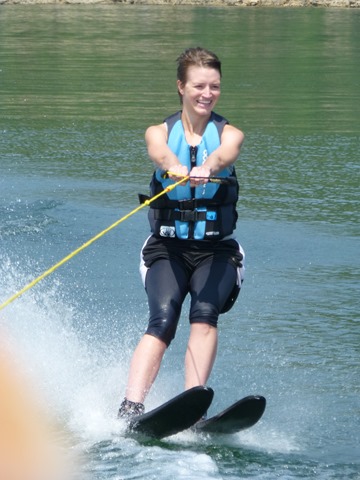
The general battery of activities includes water skiing, tubing, wakeboarding, as well as general lounging and exaggerating tales of previous exploits.    

 P1020435
   P1020407

DSC03673
DSC03661
DSC03652
DSC03713

Evenings we generally spend doing as little as possible and nursing rashes from neoprene and sun alike.  This year almost everyone under the age of 35 brought their own laptop.  I made a terrible mistake and introduced everyone to the original Roller Coaster Tycoon.  So it was in this way many an evening were lost in silent contemplation of the deepest questions: How do I make this roller coaster faster? and, Why do my guests keep dying?

rct2

rct1

All in All a good vacation.  I only ended up having to repair a few minor issues totaling around 3 hours of time.  A new record I think.  As I finish writing this we are heading to another lake, although this one is in Honduras, and for different reasons.