Saturday, May 11, 2013

Un-Belize-able Time, Part 2

Thursday

We left Cucumber Beach Marina and headed along the Western Highway and the Hummingbird Highway to Hopkins. The Hummingbird Highway is really a very pretty drive through mountains and tropical forests.

DSC03524

After leaving the relative quietness of the highways, we drove 7 miles along a dirt road to Hopkins. With nothing other than North Side or South Side to direct our search for a place to sleep, we picked the road closest to the beach and went south. We went to the one that supposedly had air conditioning, All Seasons Beach House. They only had 2 rooms left, at expensive prices (relatively speaking) and the one we chose only had fans, no A/C. Jonathan was already tired of looking, though so we went with it.

DSC03540

DSC03539

We wanted to go snorkeling, so we walked down the road to the person the owners had recommended. We talked and they said $50USpp. I didn’t know if that was what I wanted to commit to yet, so we walked away from the deal to get some lunch. After a bit of rest and research ($50USpp is the going rate), we walked back over and said we wanted to go the next morning. She said it would be $50USpp, and then said it would be $300BZ total. That meant $75USpp. It was too much for us, so we said no and left. We decided the day would be best spent relaxing.

DSC03531

Friday

After a night of fitful sleep between the hard beds, barking dogs, and critters running around in the attic (rats maybe?), I got up early. It was daylight (at 5am) and with the creatures scurrying around upstairs, I wasn’t going to be getting any more sleep. With me up, Jonathan followed an hour later. We were up way earlier than expected, but with nothing to do there, we took off for our next activity: cave-tubing in Nohoch Che’en Caves Branch.

We arrived an hour early at Cavetubing.bz, but they took it in stride and called up our guide, Alfredo. They were very gracious and professional. Soon, we were driving to the site, where we walked our tubes up the river. Along the way, our guide took the time to tell us about unique Belizean plants and animals. He even ate some termites for us. Apparently they taste like peppermint (everything else tastes like chicken). It made the scenic route even more interesting.

DSC03555

When we arrived at the river, we decided to try some cliff jumping.

DSC03566

The tubing was calm and scenic. It takes about twice as long to get back via tube than it does to walk there.

DSC03585

DSC03612

Here is what you need to know if you are considering cave-tubing (the rest of you can skip ahead):
  • the going rate from online vendors seems to be $50USpp, whether you are picked up or meet them at the location.
  • they make it sound like you get a special jungle hike in addition to the cave-tubing; this hike is required to get you to the point where you start tubing. Now, if they provide informational stuff along the way, that is an added bonus.
  • you can drive to the park yourself, but you must have a guide to cave-tube. You can pick these up as you leave the Western Highway at Mile Marker 37. These guys are supposedly cheaper, but they aren’t as professional-looking and have a more pushy attitude (must get a driver’s attention somehow), but they are licensed. I do not know if they provide any extra perks like telling about the local fauna and flora along the hikes. You can also stop at the offices of advertised services along the way and pick up a guide there. It will probably take a bit of time to call a guide in, though.
  • as we left the last cave, we saw a tour group in front of us actually stop there and pick up their tubes to walk the last bit back. Our guide with cavetubing.bz actually let us continue tubing to the point we crossed the river initially to start the jungle hike, adds another 10 minutes or so of tubing.

Saturday

The day began with me waking early and having to make a decision: should I try to blog some more to catch up, or should I start making pancakes as that can take a while? See, I had run out of fruit to eat for breakfast the day before. So in honor of it being a Saturday (old ritual from back when it mattered), I decided to make pancakes instead of just eating some PB&J for breakfast. Deciding Jonathan would be annoyed if I took too long to get ready, I decided to start breakfast. Unfortunately for him, it just woke him up as I searched everywhere for my missing vanilla, so he wasn’t exactly excited about that either. The pancakes turned out alright, well at least for me. I have a hard time regulating the temperature of the frying pan for pancakes, so the second batch burned and Jonathan didn’t get any.

Saturday was the day we planned to cross the border, and on the way, we stopped at Xunantunich, a small Mayan site. While it is one of the most easily accessed sites, you have to get there in a very unique way: crossing the river in a hand-cranked ferry.

DSC03622 Apparently there is not enough traffic to warrant a bridge yet.

 DSC03643 View from the ferry.

Then at the top of a very steep hill (I believe we had to drop Chuck down to 1st gear to get up), the small site awaited us. Climbing the top of its tallest pyramid provides you one of a more the most scenic views I have seen from a pyramid (the ones in the Yucatán only provide a view of plain of unvaried tree tops—a bit boring). 

 DSC03633 From the top, you can see Belizean mountains and the nearby town of San José Succotz. Supposedly you can see Tikal from here on a clear day, but it was too humid to see very far.

Our explorations in Belize complete, we drove to the border. Borders in some of these places are interesting. Belize being no exception. In Belize, you have to pay a departure tax. So to get your exit stamp, you have to park your car and go inside.

http://cienagacreekranch.files.wordpress.com/2013/04/p1050995.jpg
Love the sign! Who uses alight? In fact, I thought it meant “to get on” not “to get down” but I was wrong. a·light /əˈlīt/ Verb (of a bird) Descend from the air and settle: "a blue swallow alighted on a branch".

First, we had to pay, then we went to another booth, where they stamped our passports. Then we had to go to the other side of the building (where those entering Belize go) to get our temporary vehicle import permit canceled. After haggling with some money changers, we got back to the vehicle and drove across the border after presenting our passports again.

To be continued in: Another Country.

Wednesday, May 8, 2013

Un-Belize-able Time, Part 1

(Unfortunately I cannot take credit for the creativity of this title; I stole it from our cave-tubing guide.)

Monday

Today was the day to cross the border, we left our lakeside campground at Laguna Azul and went south. After filling up on gas (at the border the gas was only ~$3.60/gal here versus ~$5.60+/gal in Belize). When we hit the México side of the border, we were waved to park and get our passports checked. In our guidebook, we were told that we would be able to keep our tourist card and just pay a small fee to get it stamped “Doble Entrada.” However, the official at the gate said that the “Doble Entrada” was a myth and took our tourist cards and receipts. He said we could get new 180 day passes when we came back. Then a (unofficial) guy tried to direct us to the both where we could get our temporary vehicle import sticker removed. We ignored that and went on as we would be coming back within the time limit on the sticker.

Then, we drove over the bridge to Belize. We weren’t exactly sure where to go. As we proceeded forward, we saw a small white building on the right offering insurance, but as it wasn’t by the Belizean government, we decided to bypass it. Then we saw another little white building on the right with a green road sign that said “Mexico” and had an arrow. I wasn’t sure what that was supposed to mean. As we drove past it, I saw a sign on the building that said something about rates. I thought that might be the insurance place, so I told Jonathan to turn around and go back. As I went to go check out what it was, someone else pulled up and a guy came out and sprayed his tires. Ah, the fumigation place. So, Jonathan pulled up as well. We paid the $5 US, got our receipt (to show to the border crossing officials later), and got our tires sprayed. I then asked him where to go, and he pointed out the road.

We drove forward and found some parking next to the “Customs Gate.” So, we parked. The officials outside told us we needed our paperwork and to walk into the Customs building. We went on in and got our passports stamped and then got in line for the vehicle import. The official there seemed to have a bit of a “concentration issue,” as he kept talking other officials and checking his phone (and answering it) and then struggling to pick up where he left off on the paperwork. Several minutes and a few signatures later, we had our vehicle import stamped on Jonathan’s passport. They asked if we had luggage to inspect, we told them it was all in the car and would hard to be brought over there. They waved us on. We got instructions for the next step, drive the vehicle through the gate and pick up the insurance at the large white building that you could see from there.

We made it through the customs gate with only a cursory inspection of the contents of the vehicle. Then we found the insurance building. It cost us $29 for a week in Belize, and we were out in less time than it took to get the vehicle import permit. We were told to put the insurance sticker in the lower corner of the driver’s side of the windshield. Turns out that all the locals get to put theirs on the passenger side. Makes us stand out, especially at those police and military checkpoints of which the Belizean insurance guy said that there weren’t really any. He lied. There were several. One of which helped us realize we had missed our destination. See, one of the first things we noticed was that Belize doesn’t believe in road signs, especially the kind that tell you the streets or directions. So, we didn’t realize we had already passed Corozal Town, where we had planned to stay that night. When we got stopped at the military checkpoint, he asked us where we were going. Once we said Corozal Town, he said that we had missed it. It was behind us. When he let us go, we told him we do a U-turn and return. This time, we found the place, I even remember passing it before, but since I didn’t think we were in the right town yet, I hadn’t checked the name so it didn’t even occur to me that we should stop.

Tuesday

Before we left Corozal Town, we made a stop by a bank to stock up on some Belizean money. And, then, because it was free and easy to get to, we decided to stop at Santa Rita, a Mayan site in town. I misread the directions and took us up the wrong road. Jonathan read the directions and figured out where we had messed up, and backtracked to the spot. When we made the U-turn to down that road, a man on a bike yelled at us. Concerned that we were breaking some kind of law, I looked back. It wasn’t a police officer, so I didn’t say anything to Jonathan. Now on the right road, we found the way pretty easily. When we stopped at the ruins, the guy who had yelled at us, caught up to us. He had apparently figured that we were searching for the ruins and wanted to make sure we made it there. Very friendly and helpful people, these Belizeans.

The site was actually being restored when we arrived. They had crews there, moving rocks, digging, etc. It was interesting to watch them work. Additionally, they were doing it all by hand. No noisy, efficient machines to assist in the work or to bother the neighbors.

DSC03410

Without daylight savings time in Central America, the sun comes up really early. And, as a result, I get up really early, which drags Jonathan out of bed earlier as well. Consequently, we arrived at Orange Walk Town earlier than expected, despite the detour we took when we missed the turn to get to Orange Walk (I did mention that Belizean roads are obnoxiously unsigned). Fortunately, when we did, a guy chased us down and told us that we were going the wrong way. He then pointed us in the right direction as he turned back around to go wherever he had been headed.

Since it was so early, I thought we could make a stop by a bakery. We pulled into town and found it to be a set of confusing one-ways and narrow, crowded streets. So we decided to try to find some parking and walk. That turned out to be pretty hard. One guy signaled us to try to park in a small spot. However it was too small and the guy behind it wanted out (after we tried pulling in), so we pulled out and continued on. Fortunately there was a spot just around the corner (or at least we didn’t see a sign and didn’t get a ticket for parking there). As we parked, the guy who tried to help us park earlier came and started talking to Jonathan. Super friendly people, as I said before, a bit uncomfortably so, at least for us anti-social engineers.

After getting some goods at the bakery (some breads, a donut for Jonathan, and a carrot cake for me), we decided to go to the Belize Tourism Board office there in the middle of the plaza near where we parked. She gave us directions for how to get to the two Mayan sites that we (I) wanted to visit. The free one, Cuello, is the oldest known Mayan site in the world. To get visit, though, you have to get permission from the distillery that ones it though. So we walked over to the local plant and asked for permission. They gave it.  After a stop at the nearby internet cafe (BZ$3/hr), we went to check it out. It was outside of town in a field. We went to the wrong gate the first time, but that allowed us to get instructions on how to get the rest of the way. Then we went to the wrong gate the second time. It had large rocks in front of it, and I told Jonathan that I didn’t think we could get through. Fortunately, at that time, the guy came over and pointed to the next gate. We got it right that time.

DSC03419 The Cuello Distillery

DSC03421 The only unearthed pyramid at Cuello. You could see tons of areas that looked like more buildings buried, though.

As it was still rather early in the day, we decided to head to Lamanai via land (most visitors come via a water taxi up New River). After taking the roads, I can see why most people take the boat. The roads were bumpy and probably took just as long a boat trip would. So, if you can part with $80pp, it is probably worth it.

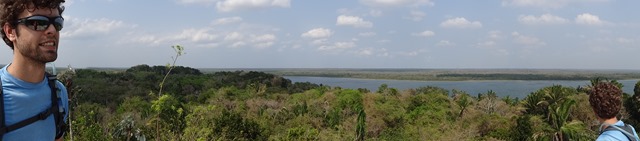
Lamanai was intriguing, mostly because of its setting. The views of the water from the pyramid was nice and there were howler monkeys. When we approached the ball court, there was suddenly an indescribable noise, something similar to a large growl at first, but it continued into a bit different sound. At first it sounded like some predatory animal like a jaguar had found distaste with us or something. I asked the groundskeeper there and he said it was the howler monkeys. The sounds they made changed over time, though. As we got farther away, it reminded me of the sounds that the Universal Studios Jurassic Park ride plays to make you feel like you are in a jungle surrounded by dinosaurs.
DSC03467Clones!

 DSC03452 Check out how large these Cohune palm leaves are! 

DSC03478 As we neared the visitor’s center to leave, we finally saw the howler monkeys.

DSC03479

After we finished, we tried to find a place to sleep there. We asked the park rangers, but they said that couldn’t interfere with local businesses. We found a eco-lodge recommended in our guidebook, but they wanted $178US for a bungalow. Just so you know, eco-lodges are just an excuse to provide you a buggy, cheap room (made palapa-style) with no air conditioning, if they are really good, they provide you a mosquito net over the bed. I am not really into eco-lodges especially when they charge an arm and a leg for it. They told us there was a cheaper place in town called Gonzalez Guest House, but they didn’t provide good directions for it, just that it was orange. After wandering through the small town, we eventually found it. They wanted $80BZ ($40US) for a room with hard beds and cold showers. After we agreed to it, she told me that the main water line in the town had busted that day and they hadn’t fixed it yet. There was only enough water left in the lines to use the restroom, not shower and they would bring us a bucket so we could rinse off. All that money and we couldn’t even get a shower, just wouldn’t work for us. If we drove back to Orange Walk Town, we could get a shower for $15 US. So, we got refunded and drove back to Orange Walk Town.

On the way back, our GPS took us on a different route, through Shipyard, a Mennonite village. Apparently, just before sunset is the popular time for the women and children to go on a buggy ride. One of the best sights was an old grain-hauling truck cab, stuffed with 4 or 5 Mennonite men, all wearing overalls and hats. They looked a bit cramped, and I am impressed they weren’t hitting each other in the ears with the brims.

DSC03491

One interesting thing about this Mennonite colony is that there were no beards on the men. My Mennonite relatives all grow beards once they get married. I guess it is too hot and humid here to have them.


Wednesday

We rose and got ready without much fanfare and drove to Belize City. We were thinking we catch a ride out to the Cayes from there and go snorkeling. After navigating through the narrow, crowded streets of Belize City, we were stopped a military checkpoint. The guys were confused by us, I guess. At first, they tried to tell us that our insurance was expired. I explained we still had 4 more days or so. Then after that was cleared up, they needed to have our passports in addition to Jonathan’s license. We literally spent 5 minutes there while they filled out paperwork. The second guy wanted to make small talk and talked with Jonathan about the van and the GPS, how he needed to get one himself to do some traveling. As it was taking a while, I asked him if there is a lot of paperwork for tourists. He said no, that they do this to everyone they stop. I guess we just attract attention… Finally, we made it to our next campground, Cucumber Beach Marina. Already hungry at 10 am (we had been up since 6am), we decided to head into town eat at Dit’s Restaurant, a hole-in-the-wall restaurant that is popular with both locals and tourists.

Our GPS told us the restaurant was near the canal that it dropped us off at. So, finding the first parking spot that we could, we got out to walk the rest of the way. I found what I thought was King Street, but decided to ask a road worker to be sure. She said that it was and then proceeded to give me directions to restaurant that I wanted to go to. As a “favor” to her kindness she wanted a dollar to buy herself a water. I didn’t have any. And as we started walking we were regaled with offers of taxis. We walked and walked and walked. Jonathan was ready to give up and cook something ourselves. But, then I saw a house number, so we continued walking to find out if the numbers were going up or down. We finally found another; they were going down, which was good. Then we crossed over another canal and it was right there.

Map picture
Pins from left to right: where we parked, where the GPS said it was, where the actual restaurant was. (Notice all the one-way streets)

The restaurant wasn’t anything I would have chosen to eat at, based upon looks alone. At least it was clean inside. You go to the window/register area to order, then you go sit down, and they bring the food to you. Kinda half service like you get at a Hardee’s or Carl’s Jr.; I believe this is a result of the fact that Belizeans, as a general rule, don’t tip. I had read about some of the traditional Belizean meals, so I figured we would try one out. Their menu was small, so there weren’t a lot of options. We went with the stewed chicken and rice and beans. As an interesting note, in Belize, there is a distinction between rice and beans and beans and rice. With rice and beans, the two items are made in the same pot at the same time. With beans and rice, the beans are made separate from the rice and to be spooned over the rice when you are ready to eat.  For both combinations they use red beans and cook them in coconut milk.
 DSC03505

The rice and beans were excellent. The chicken was very tender and juicy, but it had a combination of spices that was a bit weird to me—not that it was bad, just a bit too foreign for me, maybe. Oh, and there was a fried plantain (or banana—not sure which)! Have I ever mentioned how much I love these?!?!

When we paid, I picked up a lemon pie for dessert for later. It wasn’t what I was expecting. Where I grew up, lemon pies were lemon custard pies piled high with meringue—a recipe that had been passed down through generations of Mennonites. This was not a custard. It is simply a lemon and milk (and sugar?) mixture. No meringue or whipped cream on top either. I asked the person behind the counter (I assume the owner) about it, and she said there were no eggs at all—so Jonathan could enjoy it as well. I must admit that when we ate it a few hours later, it was heavenly.

DSC03508 

As we walked back to the van, I reminded Jonathan that we were in desperate need of getting some laundry done. We were tired and in no mood to figure out how to do the snorkeling, but we needed laundry. There was one laundromat mentioned in our guide book, so we got in the van and attempted to navigate the maze of Belizean streets in our van. It wouldn’t be so bad—they are mostly square—except that there tons of one-ways and a plethora of road construction. I was able to direct Jonathan to the street the laundromat was on, but between the road being narrow and there being nowhere to park and getting farther and farther away from our location as we tried to circle back to it, we decided to try the one we saw when drove into town the first time. As I tried to get us to the road, we crossed over the only manually-operated swing bridge remaining in the world. After this comes the fun part. I mentioned that there is a ton of road construction in Belize City. We went down the road from the bridge, looking for a place to turn left. After we did, we ran into road construction. Our only option was to turn left again. When we did, we ran into another road block, just another block in. So we had to do a U-turn. Then, thinking that the way we came was blocked we decided to try to get back over to the bridge road, by turning right. This turned out to be a dead end (I had only looked far enough ahead to verify it was a one-way in the direction we wanted, not enough to see the dead end). So we backed ourselves out of there and went back toward the original road construction that had detoured us. Fortunately the backhoe had moved and we could continue straight through the road. At this point, tired and frustrated with Belize City roads, we decided to go back to the campground and figure something out later. I managed to get us there without any more mishaps.

DSC03507 You can see the road construction behind and two vehicles trying to get turned around.

We decided to take a short break—check some email, etc. and then work on some laundry. The marina did have laundry machines, but they weren’t hooked up and didn’t have the tokens required to start them. So, with no other options than going back into Belize City, which really wasn’t an option in our minds, we decided to do laundry by hand. It was quite the system. I would soak and scrub the laundry in our trash-can-turned-wash-bucket, and then stand in the shower to rinse it. Jonathan would wring them out and hang them on some lines strung from our van to the nearby porch of an abandoned building.

DSC03511
DSC03512

After all this, it was time to rest for the rest of the day. Definitely an interesting one.

Tuesday, May 7, 2013

Mayan Ruins Explorations in the Yucatán

The lure of México for some people, including me, is the ancient civilizations. México was home to 2 of the 3 major Native American civilizations: the Aztecs and the Mayans. While I plan to hit up the Aztecs (in the interior near the Ciudad de México) on the return trip, we are currently exploring the Yucatán, which is the home of the Mayans.

Starting in Villahermosa, we visited the La Venta museum, which houses several relics from the Olmecs. The Olmecs were an ancient civilization believed by some to be the predecessors of the Mayan and Aztec civilizations. They are famous for their large, carved stone heads.
 
DSC03044
 
It was interesting to see their artifacts, but there was also a small zoo as part of the museum. I decided I needed a margay. Too cute! And almost house-cat size!
 
DSC02999 I want one!!!
 
From there we made our way towards Calakmul. On the way, we stopped at Balakmú. While the structures themselves aren’t that impressive, the frieze that is kept under the largest pyramid is impressive.
 
DSC03079
 
Next site was Calakmul. I think this was our favorite site. It is a large complex with 3 large pyramids. In fact, the tallest pyramid in the Yucatán is located there. As an added bonus, you can still climb these structures. While the site did not have as many intricate details in the architecture, it was climbable, extensive, and nearly deserted.
 
DSC03124
 
After that we decided to do some of the sites along the Puuc route, starting with Uxmal first. Uxmal is nicely excavated and has many intricate designs, but even at the end of the day in the off-season after a rainstorm, Uxmal was pretty crowded. Between the crowds, the smaller area, and the fact that you can no longer climb up the pyramid of the magician, it was not as enjoyable as Calakmul.
 
DSC03154 Apparently, it is  illegal to use a tripod here without a permit, as obviously having a tripod means you are professional. Sadly, it means that I don’t have many pics with the both of us.
 
DSC03162 Notice the intricate decorations in the stone on the building.

We visited three more sites along the Puuc route. For the price (less than $4USDpp), I was really surprised at the quality of the sites. Additionally, there was generally no one else there. You could also see what many structures look like before they are excavated. It is amazing that they are ever able to reconstruct them in many cases.
 
 
DSC03268 A partially-reconstructed building at the free site, Xlapak.

DSC03220 Not-yet-reconstructed Grand Pyramid at Kabah. It was huge.
 
DSC03228
The sacbé (the white roads the Mayans created) at Kabah. Used to lead directly to Uxmal.

Cobá was a bit of a surprise as well. There were at least two ball courts there. It was pretty busy, though.
 
DSC03335
 
Last, but not least, was Tulúm. This one is unique in that it was actually occupied when the Spaniards arrive. In fact, as it was right on the ocean, it was one of the first places conquered. It was disappointing in that you couldn’t actually explore any of the buildings, but it was picturesque. Plus it had a wall surrounding it (not common).
 
DSC03374

DSC03368
The wall entrance. Even assuming that time has added a couple of inches of dirt that the archeologists forgot to move away, you can tell the Mayans were a short people. Someone with Jonathan’s height would have been a giant.


The Way of Mexico


We are currently making a rather fast (for us at least) run through Mexico.  We are spending relatively little time exploring on our stops, and not much time is spent interacting with the locals.  Despite this speed, every country has a few things that are frustrating, odd, or unique.  Here are a few of the Mexican Way.

First is the building materials: cinder-block and brick are the basics, usually with some kind of stucco covering.  Although, there is a near infinite number of wall-less shanties built to provide shade, from whatever material is available.  It makes sense, stone and concrete buildings last longer and are cheaper to build overall.


Second, is their treatment of trash.  With exception to some larger cities, and tourist areas, in most of the smaller towns and outlying areas, it seems that many people just dump their trash wherever it's convenient, and if they are conscientious, they light it on fire before leaving.  I don't have any problem with burning trash, but it is often done right by the road, which can be frustrating.


The average Mexican family produces much less trash than your average American, but the ubiquitous disposablility of the consumeristic society that we live in is slowly catching up to the slower pace of life in Mexico.

Third, the Siesta.  Mexico, and many Spanish-speaking countries, practice a mid-afternoon break, often between 2-4pm (could start as early as noon, and end as late as 6).  Many businesses are closed, and the equivalent of a lunch rush occurs.  We can always tell when a local town's siesta starts, because we have multiple near-misses with pedestrians, and the street/highway-side vendors are too busy to try and hawk their wares to the wealthy gringos, in the ugly, white van.

It was interesting as we drove south to watch the street vendors' wares change to reflect what we saw being grown along the highway.  Changing from mangoes, to pineapple, and bananas to coconuts. There are many roadside lean-to structures made from whatever can be found nearby, a variety of locals will sell produce and local dishes, usually near some topes.  The iced whole coconuts with straws in them were particularly attractive inside of the German oven that is Chuck; made me want to test luck against my coconut allergy...


Fourth, the Topes, and roads in General.  As mentioned in our Baja posts, topes are a standard traffic-control device here.  Speed limits are sparsely posted, and often illogical.  They are essentially ignored by 9 of 10 drivers.  In order to protect the inordinate amount of pedestrians, there are every size, shape, state of repair, official, and non-official topes (speed bumps).   They are often unmarked, and when they are, you have about 30ft of warning.  Sometimes a sign for topes will be lying, and the road will be smooth ahead.  I regularly get Chuck's front wheels airborne when I am distracted or miss a tope in a shade, which are purposely built there so that the road workers and vendors will have shade.  On one 350Km stretch of Mex 200, there are over 200 topes.  I took us nearly 8 hours to negotiate that stretch of coastal road.

While I am on the topic of driving, In Mexico, they allow doble semi-remolques.  These are semi trucks with dual trailers.  Their total lengths are over 70ft; and they are slow.  Here is a stock photo from the internet.


Combined with narrow roads, other slow farm trucks, and the local need for speed; and driving can become very interesting.  My favorite is the 2-lane double pass.  In order to execute this maneuver, you need a narrow 2-lane road with half or quarter sized shoulders.  Take two slow trucks approaching each other, now have two cars attempt to pass, one for each semi.  Now there are 4 cars trying to use this 2-lane road, with both semis hanging off the edge.  I will try to snag a photo of this, but its hard to do when avoiding near death.  Hear is a picture of how narrow and shoulder-less the roads can be.


Here is a lineup of sugar cane trucks coming in from the fields.


Finally there are the white-painted tree trunks.  I have not heard any reason other than aesthetics for painting the trunks of trees white.  Usually its only up to about 4 feet; and to my tastes they look ridiculous, but whatever works.  It seems to be very common, wherever someone owns some trees, they seem to have the need to paint them white. It's all over Mexico and Central America as far as I can tell.


We have a bunch of posting to catch up on, hopefully some cool Mayan Ruins and southern Mexico; stay tuned.

Friday, May 3, 2013

Over the Bridges, Through the Woods…

It has been an interesting journey the last few days. After we passed over the isthmus, we started crossing over several juts of land and islands along the Gulf of México coast. There were miles of bridges over shallow waters. There were even dolphins swimming along near them. Apparently, they breed in the waters around here.

DSC03058

I may have mentioned that I HATE bugs, especially the kinds that like to eat me. As we have been traveling south, I have slowly been accumulating bites from vicious mosquitoes and biting flies. My legs are beginning to look like I have chicken pox or something. And it wasn’t like I wasn’t using bug spray. I was, but it was in the times that it was wearing off or I just slipped out for a minute (plus I don’t think it was effective against flies), that I would get bites. While going through a Commercial Mexicana, I picked up a bug repellent lotion that last 7 hours. I thought that would be perfect, especially since Jonathan hates me spraying the stuff in the van. Turns out, it works wonderfully, and I haven’t been bit since I started using it. Hopefully there isn’t any harmful side effects from using it twice a day, every day.

While passing through the isthmus of México, we passed through the first of many police checkpoints. They are similar to the military checkpoints in Baja, but instead of stopping and inspecting everyone, they only stop the gringos (or at least that is what it seems like to me). And then instead of just doing an inspection of the car, they ask for the driver’s license and the vehicle title or registration. To make this evening more annoying, these checkpoints are offered more often than in Baja, and we passed through several in a single day. I should be entertained by these, but instead I get frustrated, a result of the combination of these factors:
  1. we are being targeted for being tourists;
  2. they speak jargon in a fast, slurred way (making it hard for me to figure out what they want);
  3. unlike the military, they are slow and inefficient (it is sunny and hot—no way you should be in any hurry);
  4. (related to point 3) when we stop, I get really sweaty because now there is no breeze;
  5. I have to dig for these documents, which I keep in safe places.

One time when we stopped, we sat there for literally 5 minutes while this guy tried to figure us out. I don’t know if he was phishing for a bribe (not likely) or if he was new and just didn’t know what to do with gringos who could barely understand what he was saying or what. Perhaps he just didn’t like our international driver permit. At the same check point on our way back from Calakmul, a lady officer addressed us. Have I told you that I love women in the male-dominated workforce positions? They are so much more efficient and polite. She quickly took care of what she needed from us. And then saw my flower on my dashboard. Apparently she shares my love for Tillandsia. That was one of the more enjoyable stops. On the border of the town of Campeche, we passed some gringo hitchhikers on the side of the road next to the checkpoint. While we were being interrogated, we decided that we would go and pick them up. So we get out of the checkpoint, pull a U-turn at the next available stop, and, as a guarantee, get stopped at that same checkpoint on the other side. Then do a U-turn, pick up the hitchhikers, and go through the checkpoint again. Do they remember that they just saw us? No, they want us to pull over again. Fortunately, they didn’t signal us until too late and Jonathan was committed to getting through without having to stop and we got passed them. The one guy looked pissed, but I think the guy that interrogated us said that we had just been through there. Either way, they didn’t go chasing after us (really no vehicles to do so).

Speaking of our hitchhikers, we found them in Campeche and they were heading to Mérida. Apparently they are like us and traveling full-time. They go to someplace, travel as they can afford, then get a job there and earn some more money. Apparently they are French-Canadian and they met Australia while they were each traveling. Of course, it was inevitable that because we had passengers, Chuck would want to act up a bit. All of a sudden when we turned towards Uxmal, Chuck didn’t want to provide any power. We made a quick stop, and Jonathan jiggled the oxygen sensor and we went on, making it safely to Uxmal just in time for a rain shower to come down heavy about the time we wanted to explore the site. I will admit though, that in that heat, you really don’t mind getting soaked. You almost want to strip (almost) naked and take your (biodegradable) shampoo and take a shower in it.

DSC03151

We have talked about the heat before, but about Puerto Escondido area and farther south, it gets really humid as well. You can tell the change. Men are wearing shorts and an open shirt. Women stay in the shade of the palapa to sell their wares. When we drove through Tehuantepec, there was an irrigation canal that went through town. Grown men and women (not just children) were just sitting chest-deep in the canal, fully clothed, trying to keep cool.

And, the rainy season is commencing. It rained while we overnighted in Tehuantepec; it was our first rain this trip. A couple of days later when we stopped at Calakmul, it stormed for a little bit. Next night, the same. Today we have had a break (at least it didn’t rain on us). Should be interesting, but at least it started cooling things off for us. It actually got down to 70°F last night! It was fantastic. Our water today was below 80°F! So exciting. The morning before, it was in the 70s, but it was 100% humidity!

DSC03150

DSC03149
As you might have inferred from the previous paragraphs, we have entered Maya territory. More on that on a later post.